The fry frontier: why global processors are circling African potatoes
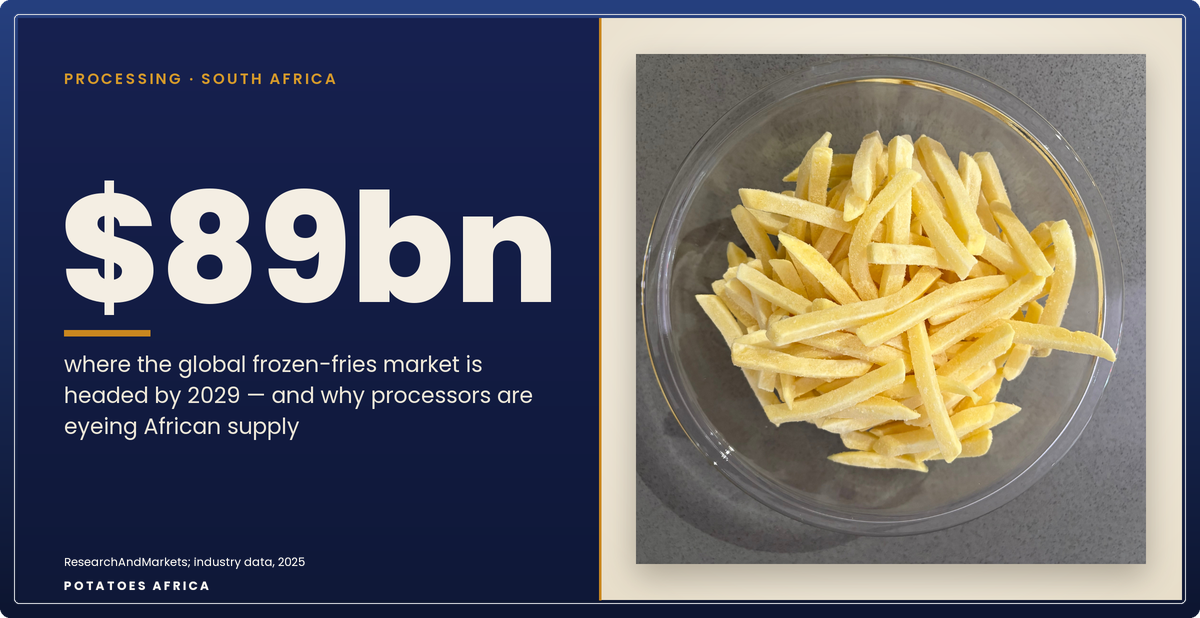
The global frozen-potato market was worth about $67 billion in 2023 and is on track to reach roughly $89 billion by 2029, according to market research from ResearchAndMarkets. The engine is the foodservice industry — the spread of quick-service chains such as McDonald's, KFC and Burger King — paired with the westernisation of diets in fast-urbanising economies. A growing share of that demand sits in Africa, where chain expansion is creating a market for fries that is today served largely by imports.
Processors are paying attention to the supply side. McCain, the world's largest maker of frozen potato products, has built a "Farm of the Future Africa" research site at Lichtenburg in South Africa — one of only a handful worldwide — to test regenerative agronomy for a local potato sector it estimates contributes around R6.6 billion to GDP. Kenya's recent history shows the pull: when KFC ran short of imported fries in 2022, it turned to local processing varieties and Kenya-based processors, jump-starting a domestic processing supply chain almost overnight.
For growers, processing offers something the fresh market cannot — a contract that rewards consistent, processing-grade tubers rather than exposing farmers to the price swings that have just crushed South African farm-gate returns. The catch is the specification. Processors need particular varieties, dependable volumes, the right dry-matter content and cold storage to hold quality between harvest and factory. Those are precisely the seed-quality and post-harvest gaps that currently cap production in Kenya, Nigeria and Ethiopia.
That makes processing both a demand magnet and a forcing function. Factories will land where the seed systems, agronomy and cold chains can reliably feed them, and the investment tends to ripple backward into farming — better varieties, formal contracts, storage and irrigation. The countries that fix those fundamentals first will capture the fry frontier. The rest will keep importing it.
The week in African potato, in your inbox
Production, trade, policy and prices across the continent — one email, no noise.