Dinah Borus: the seed scientist bringing Kenya's apical cuttings to WPC 2026
In Kenya's potato economy, the binding constraint has rarely been land or labour — it is seed. Roughly 800,000 smallholders grow the crop and about two million people draw a living from its value chain, yet most farmers still plant tubers saved from a previous harvest or bought from unregulated markets, according to the International Potato Center (CIP). The result is a persistent drag on yields. Few people have done more on the ground to loosen that constraint than Dr Dinah Borus, the Nairobi-based seed scientist who will carry the story of rooted apical cuttings to the 13th World Potato Congress this October.
The Congress bills Borus as a senior agricultural scientist based in Nairobi, and she serves the World Potato Congress as an International Advisor. At the 2026 edition in Naivasha she co-leads the event's new Rooted Apical Cuttings working group — a global network being formalised to share best practice on a method that has quietly changed how clean seed reaches farmers across Africa and Asia. On International Women's Day this year, the Congress named her among the women scientists shaping the sector's future.
Much of her field reputation was built with CIP's Sub-Saharan Africa potato programme, where she worked as an agronomist and North Rift field coordinator. Kenyan press coverage from the late 2010s sets out the work in detail: from 2016, Borus and CIP colleagues trained farmers across Nandi, Elgeyo-Marakwet, Uasin Gishu and Meru counties to multiply disease-free planting material, an effort supported by the USAID-funded Feed the Future Accelerated Value Chain Development (AVCD) programme. The technique also won a decisive regulatory endorsement: the Kenya Plant Health Inspectorate Service (KEPHIS) recognised apical cuttings and built them into the formal seed system as starter material for certified seed.
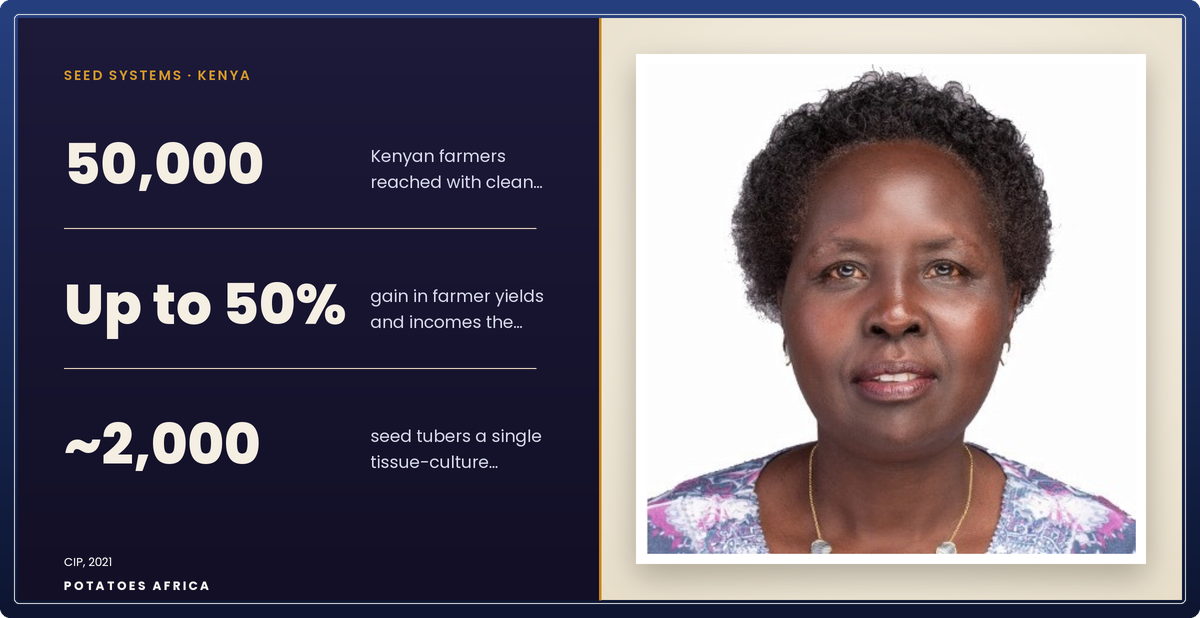
The innovation is deceptively simple. As Borus has explained it, an apical cutting behaves much like a nursery seedling, except that it is produced vegetatively from a tissue-culture plantlet rather than grown from a seed. That small difference has outsized consequences for multiplication. CIP estimates that a single tissue-culture plantlet can ultimately yield around 2,000 seed tubers, turning a few clean plantlets into enough planting material to supply whole communities. Borus has been clear that the aim is not simply to produce the cuttings but to put them to work producing seed at scale — which has meant building rural businesses rather than demonstration plots.
The payoff appears in farmers' fields. By CIP's 2021 account, the apical-cuttings initiative had placed clean seed with some 50,000 Kenyan farmers and raised yields and incomes by as much as 50% — a substantial gain in a system where a 2016 CIP survey recorded average yields of about 10.9 tonnes per hectare against a realistic potential of 20 to 30 tonnes. Just as important, the model spawned a new class of decentralised seed entrepreneurs, many of them young people and women, who buy cuttings and multiply them for local sale.
Borus has also helped build the evidence base. She is a co-author of a 2024 study in the journal Crop Science examining whether rooted apical cuttings can complement Kenya's seed systems to widen access to quality seed, and her name appears on earlier peer-reviewed work, including a 2011 paper in Potato Research on improving seed quality through positive selection by smallholders. That mix of field coordination, training and published research is what gives her account of adoption and international experiences its authority.
It is also the session she will deliver in Naivasha. Her talk, "Rooted Apical Cuttings: Adoption, Use Cases and International Experiences," is set up to draw lessons from Kenya's rollout for the many countries now trialling the technique. Around it, the working group she co-leads — with CIP's Monica Parker, WPC director Julio Kalazich and Ireland's Derek Roulston — is meant to give that exchange a lasting home, letting specialists troubleshoot problems and push adoption between Congresses rather than only during them.
Her presence resonates because of where the Congress is being staged. The 13th World Potato Congress, running from 26 to 30 October at Naivasha's Sawela Lodges, is the first held in Sub-Saharan Africa, and its programme leans heavily on partnerships for food security. A homegrown Kenyan seed solution, carried by a Kenyan scientist who helped move it from the laboratory to thousands of farms, is about as direct an answer to that brief as the agenda offers. For a sector that keeps circling the same hard truth — that potato systems rise or fall on the quality of their seed — Borus is a reminder that the fix can be at once technical and entrepreneurial, and that it can be built in Africa.
Frequently asked
Who is Dr Dinah Borus?
She is a Nairobi-based agronomist and seed-potato scientist known for her work on rooted apical cuttings in Kenya. She advises the World Potato Congress as an International Advisor and built much of her field experience with the International Potato Center's Sub-Saharan Africa potato programme.
What will Dinah Borus speak about at the World Potato Congress 2026?
She is scheduled to present 'Rooted Apical Cuttings: Adoption, Use Cases and International Experiences,' drawing on Kenya's experience to inform countries now adopting the technique. She also co-leads the Congress's Rooted Apical Cuttings working group.
What are rooted apical cuttings?
They are potato planting materials produced vegetatively from tissue-culture plantlets rather than grown from seed. CIP estimates a single plantlet can yield around 2,000 clean seed tubers, allowing disease-free seed to be multiplied quickly.
Why do rooted apical cuttings matter for African farmers?
Access to quality seed is the main constraint on potato yields. In Kenya, CIP reports the approach reached about 50,000 farmers and lifted yields and incomes by up to 50%, while creating local seed businesses run by young people and women.
The week in African potato, in your inbox
Production, trade, policy and prices across the continent — one email, no noise.