Production costs and tight supply push Nigeria's potato prices higher
A basket of Irish potatoes now sells for between ₦8,000 and ₦10,000 — roughly US$5 to US$6.30 — in markets across Lagos, Abuja and Port Harcourt, as a mix of higher production costs, insecurity in growing areas, inflation and tight supply pushes one of Nigeria's most common vegetables further out of everyday reach.
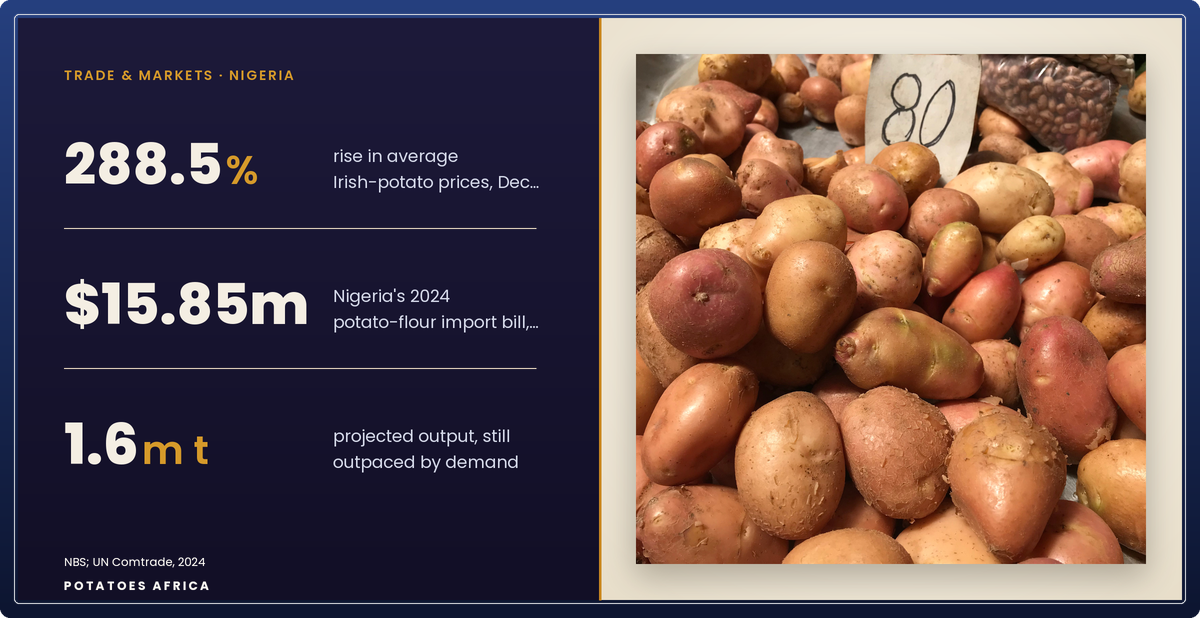
The squeeze reflects a longer climb. Figures from the National Bureau of Statistics show the average price of Irish potatoes rose from ₦541.57 a kilogramme in December 2022 to ₦2,423.27 by June 2024 — an increase of 288.5 per cent across that period, far ahead of broader food inflation. Prices vary sharply by location: Lagos has recorded some of the steepest retail rates, driven by transport costs and dense urban demand, while northern cities such as Kano stay cheaper thanks to their proximity to the Jos Plateau, the country's main potato-producing belt.
According to Olufemi Oladunni, chief executive of the Agricultural and Rural Management Training Institute (ARMTI), rising input costs and falling output are at the centre of current market conditions. "While demand is increasing, production is reducing," he said, adding that the crop still holds large untapped potential to strengthen food security, nutrition and the incomes of low-resource farmers.
That gap between demand and supply is widening even as the national harvest edges up. Nigeria's potato output is projected to reach 1.6 million tonnes, up from 1.5 million, but growth in consumption and the expansion of domestic food processing have outpaced those gains. The shortfall is increasingly filled from abroad: drawing on UN Comtrade and Trade Map data, the country has become the world's third-largest importer of potato flour, with the import bill jumping from US$3.98 million in 2023 to US$15.85 million in 2024 — a near four-fold rise in a single year. The climbing flour bill points to processing demand that the domestic crop cannot yet satisfy.
Costs at the pump are compounding the pressure. Market participants link part of the recent price increase to fuel, with diesel rising from ₦1,245 a litre in April to an average of ₦1,330 in May, lifting the cost of moving produce from farm to market. For a crop grown mainly on the Jos Plateau and trucked long distances to coastal cities, logistics weigh heavily on the final shelf price.
The market has shown it can swing both ways. A larger harvest in mid-2024 briefly eased prices, with a 65-kilogramme bag falling from between ₦150,000 and ₦180,000 to around ₦45,000 by July that year. The relief proved temporary: prices had rebounded by January 2026, and current retail rates in Lagos and Abuja run from roughly ₦447.83 to ₦1,343.50 a kilogramme. The pattern underlines how thin Nigeria's buffer is — a single good season can soften prices, but without sustained gains in productivity the relief does not last.
Seed sits at the heart of the problem. ARMTI is working with the International Potato Center (CIP) to identify early-maturing varieties that can tolerate high temperatures and resist viral diseases — traits suited to Nigeria's climate and to the twin demands of fresh consumption and processing. Oladunni said the programme prioritises planting material that is early-maturing, high-yielding and disease-resistant, the combination most likely to lift yields and steady supply over time.
Nigeria's difficulties echo a wider continental picture. Africa produced 34.2 million tonnes of potatoes in the latest Food and Agriculture Organization figures, with Egypt the largest grower at 8.08 million tonnes from 269,000 hectares. Across the region, new breeding and seed technologies are under evaluation, including hybrid true potato seed programmes in Kenya and South Africa and CIP-backed sweet potato variety trials in several sub-Saharan countries — efforts aimed squarely at the productivity gap that leaves markets exposed to cost and supply shocks.
For now, the immediate driver in Nigeria is arithmetic that favours the seller: costs are rising, output is lagging and imports are climbing to cover the difference. Closing that gap will depend less on any single harvest than on whether better seed and steadier production can take root — and whether they can do so fast enough to keep a staple within reach of the households that rely on it.

Soundararadjane S: India's potato-processing story and its lessons for Africa
The Seed Reckoning: Africa's potato seed gap, by the numbers
The 30-year hunt for a blight-proof potato reaches Africa's fields
The week in African potato, in your inbox
Production, trade, policy and prices across the continent — one email, no noise.