Côte d'Ivoire leads the world in cocoa but imports almost all its potatoes
Côte d'Ivoire is one of Africa's agricultural success stories. It is the world's largest cocoa producer, supplying around 40% of global output, the leading exporter of raw cashew nuts, and a major source of rubber, palm oil and bananas. Farming employs close to half the workforce, and the country exports more than three times the value of the farm goods it imports. Yet on one staple the picture inverts entirely: Côte d'Ivoire grows almost no potatoes, and buys nearly every one it eats from abroad.
A study by Wageningen Social & Economic Research and ECDPM, published in April 2026, examined that dependence and reached a reassuring conclusion. Far from undercutting local farmers, imported potatoes appear to fill a gap that domestic growers cannot, for now, hope to meet.
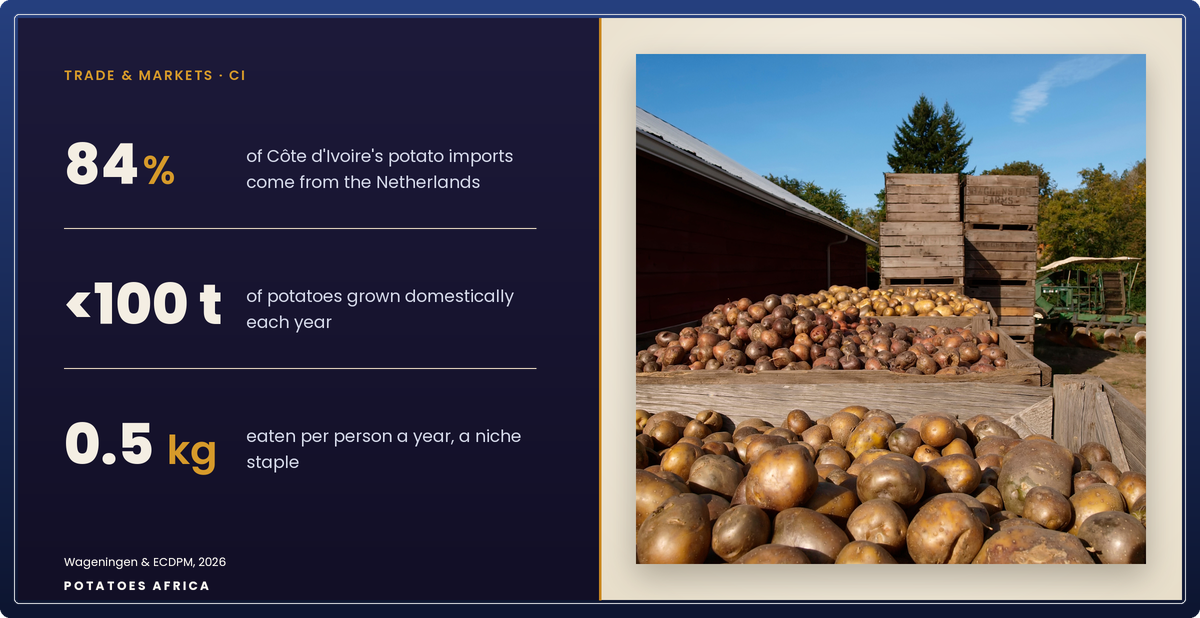
The numbers are stark. In 2024 the country imported roughly $17.4 million of potatoes, of which Dutch suppliers provided about $13 million. The Netherlands has held a commanding position for decades — between 70% and 80% of the market in recent years, and 84% on a 2020–2022 average, the highest share among the cases the researchers studied. Annual volumes have run between about 40,000 and 55,000 tonnes, topped up by smaller flows from Egypt, Morocco, Mali, France and Belgium.
Domestic production, by contrast, is close to invisible. Official figures record fewer than 100 tonnes a year — a few hectares of crop. The researchers concede this may understate reality, but there is broad agreement that output is, and almost always has been, tiny. Potato cultivation first appeared in the Touba region in 1941 to offset wartime shortages; state-led efforts to industrialise the chain from the 1970s fell well short.
That absence is not for lack of demand. Potatoes remain niche — per-capita consumption was just 0.5 kg in 2023, rising to about 1.2 kg in Abidjan — but a fast-growing, urbanising population is lifting total volumes even as the per-head figure stays flat. Côte d'Ivoire added more than 7.5 million people in a decade, a rise of over 25%. A dietary shift is reinforcing the trend: more fast food, delivery services, modern retail with quality standards, and small local processors turning out crisps and chips. Imported Dutch, Belgian and French potatoes, prized for their shelf life and consistency, are the preferred type for fries and stews.
Nor is the problem simply climate. Northern districts around Korhogo, and the western Tonkpi region, offer cool dry-season conditions, irrigation and suitable soils. But cotton and cashew pay better there, government support for potatoes is thin, and growers familiar with sweet potatoes have little experience with ware potatoes. Start-up costs are steep: 40% to 60% of a grower's outlay goes on imported seed, fertiliser and chemicals exposed to volatile exchange rates. Storage suits the tropics poorly, and in humid Tonkpi heat and moisture can destroy a whole crop without costly fungicides. The country also lacks varieties bred for its rainfall. Building a chain, the report stresses, takes years — though 15 to 20 tonnes per hectare is thought achievable with adapted varieties.
Could trade policy help? In principle, the tools exist. Under the ECOWAS common external tariff, fresh potatoes already carry a 20% duty that can climb to 35% as a strategic good, while seed potatoes face just 5%. Yet the study doubts restriction would build a domestic sector. Dutch potatoes could readily be replaced by France, Belgium, Morocco or Egypt; tariffs on neighbouring ECOWAS producers are diplomatically awkward to raise; and the African Continental Free Trade Area may further limit such barriers. Protectionism, in other words, would change the source of imports more than the lack of local production.
The data bears out the complementary picture. Price records for ware potatoes are sparse and patchy, but lower Dutch prices simply draw larger volumes — the ordinary behaviour of demand — with no sign of imports depressing local prices, which have been stable and gently rising. The producers' association, APPT-CI, does not yet regard Dutch imports as competition, given how early its own cultivation remains.
The more promising lever, the researchers suggest, is seed. Côte d'Ivoire imports only modest volumes of seed potatoes — some 300 to 400 tonnes in recent years, plus 500 tonnes from Egypt in 2024 — yet exposure to high-quality material is already spurring interest in better varieties, agronomy and post-harvest practice. Dutch cooperation, through projects such as HortIvoire and the prospective HortiNord programme in the north, is channelling training and knowledge transfer. With APPT-CI now working alongside the national extension agency ANADER, a domestic sector may slowly take shape — if the country can resolve its bottlenecks in inputs, finance and storage.
Frequently asked
Does Côte d'Ivoire grow its own potatoes?
Barely. Official figures record fewer than 100 tonnes a year, and almost all the potatoes consumed are imported, mostly from the Netherlands.
Would tariffs help build a domestic potato sector?
The study is doubtful. Higher duties would mainly shift imports to France, Belgium, Morocco or Egypt; investment in seed, finance and storage is seen as the more effective lever.
Kenya bets on a single national cooperative to fix smallholder bargaining power — details are still thin
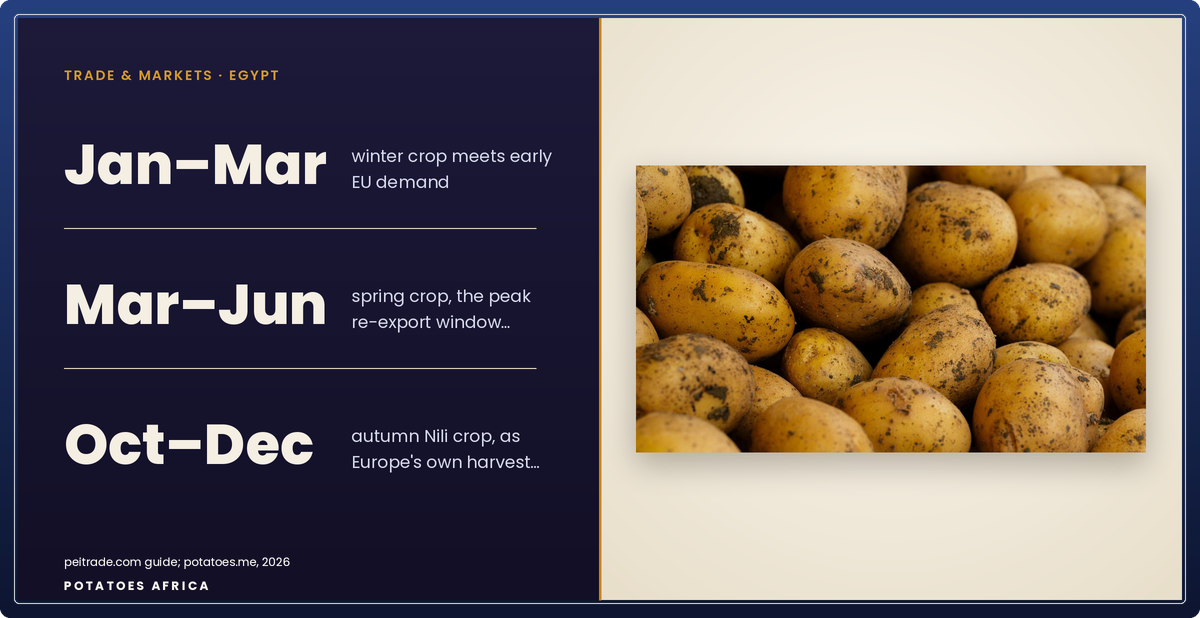
Egypt's potato corridor to Rotterdam runs on Dutch seed and a narrow calendar
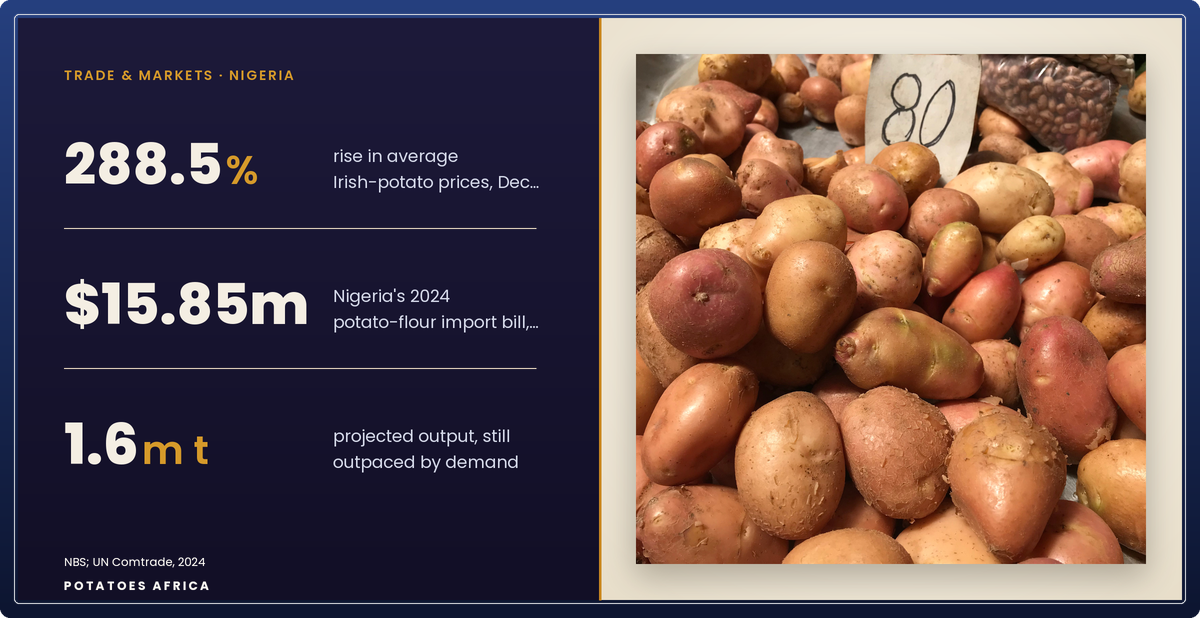
Production costs and tight supply push Nigeria's potato prices higher
The week in African potato, in your inbox
Production, trade, policy and prices across the continent — one email, no noise.