How Egypt turned the desert into Africa's potato export engine
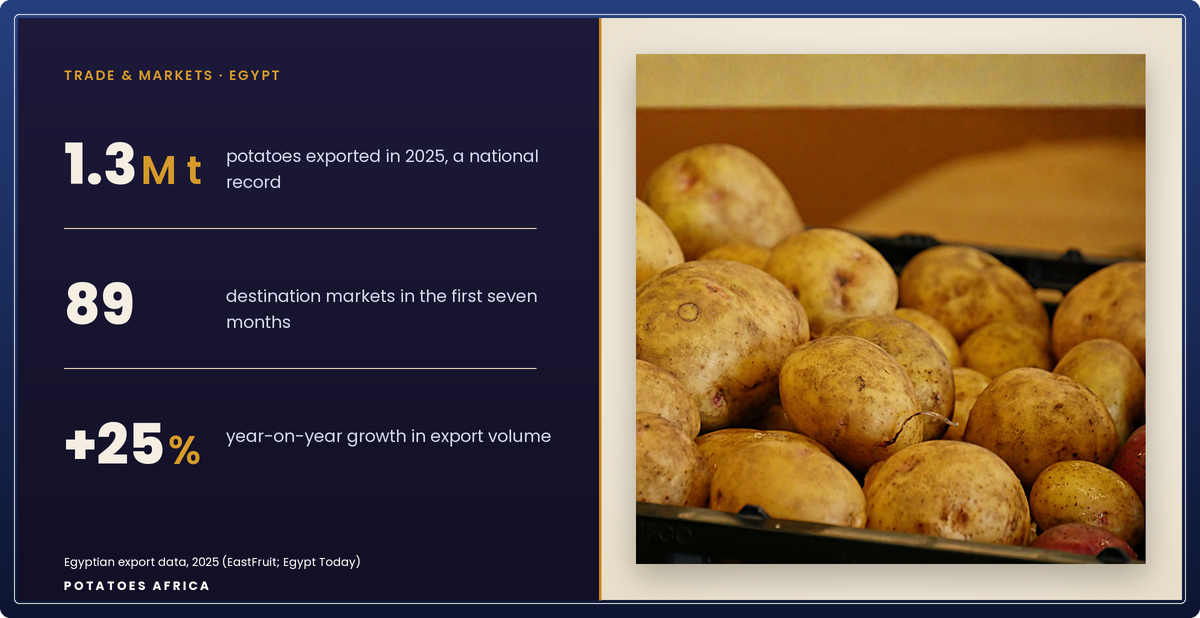
Each winter, while much of the northern hemisphere waits for its own crop to come out of the ground, container ships leave Egyptian ports loaded with potatoes bound for Moscow, Athens, London and the Gulf. By the time the 2025 season was tallied, Egypt had shipped more than 1.3 million tonnes — a record — to roughly 89 countries, confirming its place among the world's largest potato exporters and, by a wide margin, the largest in Africa. Within Egypt's own farm economy, only oranges earn more foreign currency.
It is an improbable position for a desert country, and it did not happen by accident.
The desert engine
The paradox at the centre of Egypt's success is that almost none of its export potatoes are grown on its best land. The Nile Delta — the historic heart of Egyptian agriculture — is largely shut out of the export trade. The crop that actually leaves the country comes off reclaimed desert: sandy, newly irrigated land in governorates such as Beheira and the Nubaria district west of the Delta, where two main plantings a year are possible and, in places, a third.
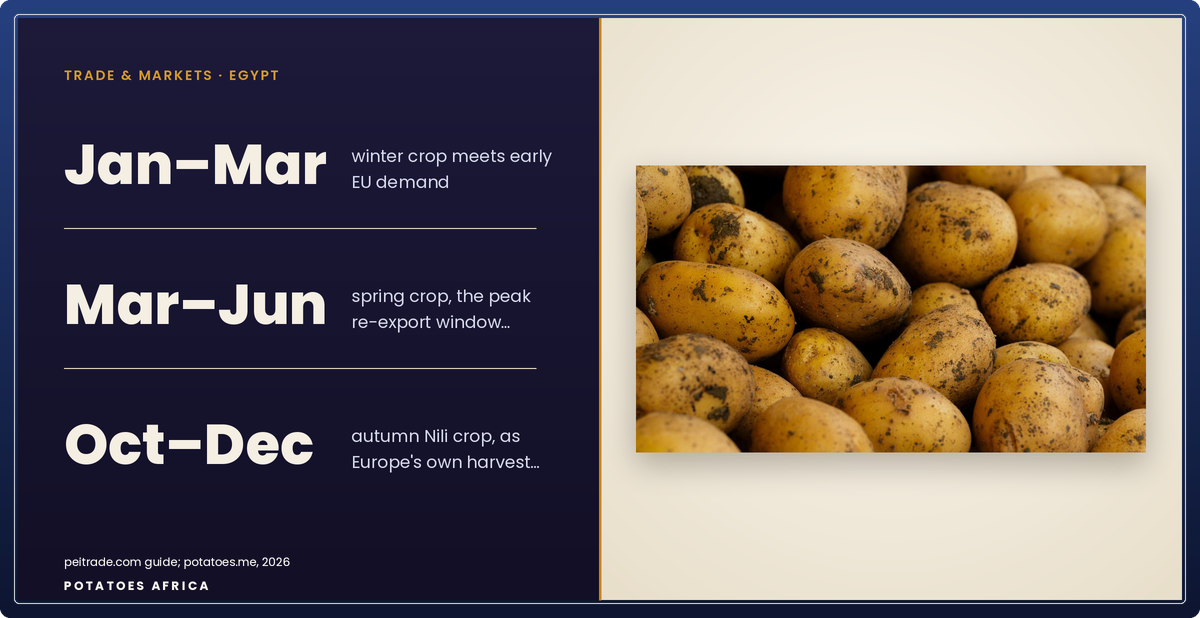
That calendar is the commercial heart of the business. A winter crop lifted from around January puts fresh Egyptian potatoes onto the market precisely when European and Russian stores are running low, and cold storage then stretches the selling window through to October and, increasingly, December. Cheap supply, arriving at the right moment, is the foundation of everything that follows — exporters reported 2025 volumes up about a quarter on the year, helped by a strong harvest and competitive prices.
The brown-rot moat
The reason export potatoes are banished to the desert is a single bacterium. Potato brown rot, caused by Ralstonia solanacearum, is endemic in the soils and irrigation canals of the Delta, and it is a quarantine pest in the European Union — Egypt's anchor market. Since the late 1990s, and under emergency measures formalised in 2011, the EU has admitted Egyptian ware potatoes only if they are grown inside designated Pest-Free Areas: blocks of desert land surveyed and tested by Egypt's national plant-protection service, with the Delta and Nile Valley excluded outright. A single interception of infected tubers can shut an exporting site out of the European market.
That regime is a burden. It is also a moat. It has forced Egypt to build the thing most aspiring exporters lack — a disciplined apparatus of field surveys, traceability and certification that European buyers have learned to trust. At times the EU has absorbed somewhere between 70 and 90 percent of Egypt's potato exports, and that access rests entirely on keeping brown rot out of the export chain. The bar is still rising: from the end of 2028, EU rules will require a clean disease record stretching back several consecutive seasons at each production site, raising the cost of staying in the club.
Spreading the risk
Concentration is the quiet danger in Egypt's trade. Russia is its single largest customer, and the relationship cuts both ways — when a poor 2024 Russian harvest cut domestic output by an estimated 14 percent, Egyptian exporters stepped neatly into the gap. Greece is the second-largest destination, typically buying late in the marketing year when Greek stocks thin out.
But leaning on one or two big buyers is precarious, and Egyptian exporters have spent recent years widening the map. Record shipments went to the United Kingdom as frost hit rival suppliers like Cyprus; a deliberate push into the Far East has seen even minor markets such as Malaysia grow at triple-digit rates year after year. The point is less any single destination than the insurance the spread provides. Eighty-nine markets are far harder to lose than five — a lesson Egypt absorbed the hard way during earlier EU interception scares.
The seed it cannot grow
For all its export muscle, Egypt carries a dependency it has not resolved: seed. The country imports the bulk of its seed potato, overwhelmingly from Europe, which means the price and availability of next season's crop are effectively set in Dutch and German warehouses rather than Egyptian ones. A weak pound and volatile freight have made that exposure expensive. Egypt's Agricultural Research Center has begun breeding the first genuinely local varieties aimed at trimming reliance on imported seed — a slow project, but one that points at the real frontier of the sector's growth, alongside the perennial fight to cut post-harvest losses in the cold chain.
The lesson for the rest of Africa
Egypt's rise is the template that every African country with export ambitions studies — and a caution in the same breath. Kenya, Ethiopia, Algeria and others have the agronomy to grow more potatoes than they consume. What they typically lack is the unglamorous machinery that converts a surplus into a shipment: the phytosanitary credibility, the cold chain that holds quality across weeks of transit, the buyer relationships that survive a bad season.
Egypt assembled all of it over three decades, under the constant discipline of a market that will close the door at the first sign of disease. The potatoes, it turns out, are the easy part. The system built around them is the hard part — and it is the part that pays.
Frequently asked
How much potato does Egypt export?
Egypt exported more than 1.3 million tonnes of potatoes in 2025 — a record — reaching around 89 countries in the first seven months of the year alone. It is consistently ranked among the world's top five potato exporters and is comfortably Africa's largest.
Why can't Egypt export potatoes grown in the Nile Delta?
Potato brown rot (Ralstonia solanacearum) is endemic in the Delta's soils and irrigation canals and is a quarantine pest in the European Union. To keep market access, the EU requires Egyptian export potatoes to be grown in designated Pest-Free Areas on reclaimed desert land, with the Delta and Nile Valley excluded.
Who buys Egyptian potatoes?
Russia is the single largest destination, followed by Greece, with the wider EU historically taking the bulk of shipments. Egypt has been widening its map into the United Kingdom, the Gulf and the Far East to spread its risk across more markets.
In Egypt, the test for Western potato varieties isn't genetics — it's local proof
Egypt's potato corridor to Rotterdam runs on Dutch seed and a narrow calendar
The missing middle: why aggregation decides who profits from potatoes
The week in African potato, in your inbox
Production, trade, policy and prices across the continent — one email, no noise.