Dieleman Potatoes takes aim at Uganda's seed-potato gap
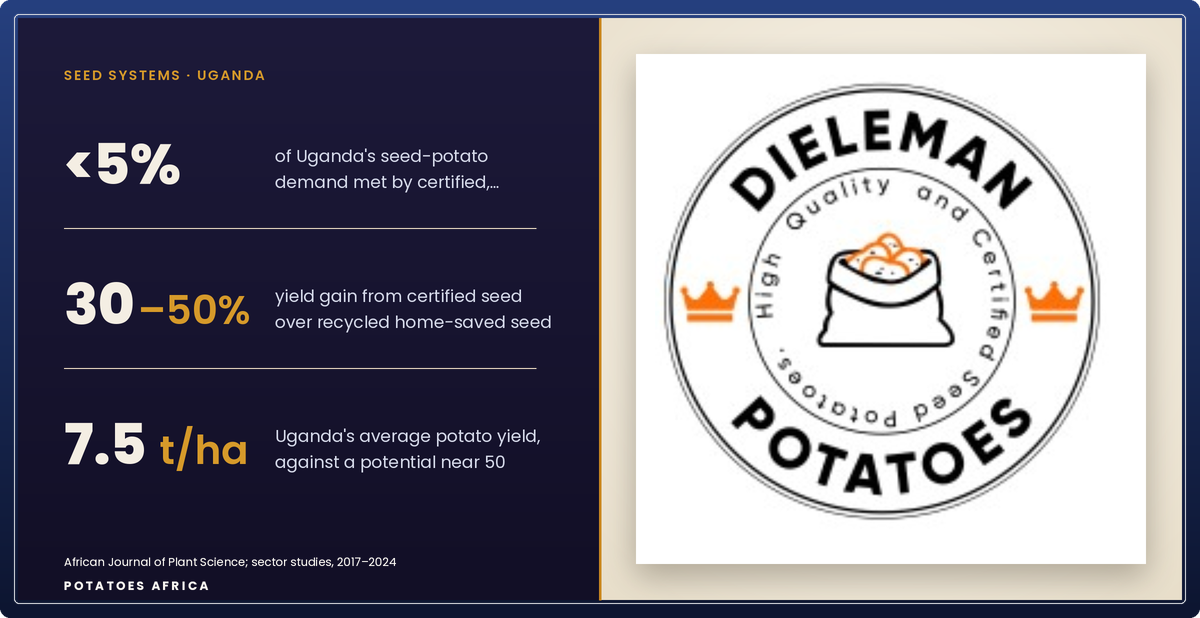
In Uganda's highland districts, where potatoes are both a staple food and a leading cash crop, most farmers still plant tubers saved from the previous harvest. Research places the informal sector's share of the seed market at more than 90 percent, with certified, disease-free seed accounting for under five percent of demand — a roughly 95 percent gap between what growers use and what their fields would need to perform. The penalty shows up at harvest: Ugandan potato yields average around 7.5 tonnes per hectare, against an agronomic potential closer to 50, according to studies published in the African Journal of Plant Science and field research from Makerere University.
Certified seed is the lever most often cited to close that gap. Trials referenced across the sector suggest clean, registered seed can raise yields by 30 to 50 percent over recycled material. The constraint has rarely been the agronomy; it is supply, logistics and trust — moving authentic, inspected seed to dispersed smallholders who have learned to be wary of a market saturated with counterfeit product.
It is into this gap that Dieleman Potatoes, a Dutch-Ugandan venture founded in 2024 and based in Kampala, has positioned itself. The company is the official Ugandan agent for Agrico, the Dutch breeder and seed-potato house, and its proposition is narrow but deliberate: source registered varieties through tightly controlled channels, then build the advisory and logistics scaffolding around them that smallholders need in order to benefit.
The supply line runs through Kenya. Agrico Potato Services Africa, a joint venture, has supplied the East African market with seed potatoes from a cold store in Nakuru since 2016. Dieleman draws its starting material from there, under inspection-service control, and distributes it to Ugandan growers through cold-chain logistics timed to the planting season. Its flagship variety is Markies, already listed on Uganda's national variety register and well established across the border in Kenya; a second, Manitou, is working through registration.
What separates the model from a straightforward import business is what the company layers on top. Alongside certified seed, Dieleman Potatoes offers farm advisory services and drone-based field analysis, and frames its work as building an "ecosystem" in which seed is paired with training, extension support and links to buyers. The objectives it sets out — diverse global sourcing, strict quality control for disease resistance and high germination, regionally tailored offerings and a reliable delivery network — amount to an attempt to address the whole bottleneck rather than a single link in it.
Behind the venture is Mark Dieleman, who arrived in Uganda by way of a career in the Netherlands' potato sector. As a project manager for the Dutch agronomy firm Delphy, he ran open-field cultivation projects aimed at improving smallholder systems, work that took him across Rwanda, Kenya, Ethiopia, Angola, Zambia, Zimbabwe and Nigeria. He met his wife at a Ugandan trade fair, and the couple settled in the country. He continues to consult alongside the seed business, including advisory work for other agricultural input suppliers.
By his own account, the work is slow and relationship-driven. Dieleman has been candid that doing business in the region rewards reputation over quick returns, and that a market saturated with counterfeit seed puts a premium on simply being present and proving reliable over time. "Working in Africa is tricky, but it offers plenty of opportunities," he told the trade outlet FreshPlaza. The harder problems, he notes, are logistical and regulatory — moving inspected seed across a border and clearing registration for new varieties — which is where a simple-sounding idea becomes complicated.
His stated ambition is straightforward: that Ugandan farmers earn more from their land through better yields and closer connections to buyers. The economics are not trivial. Potato in Uganda is grown overwhelmingly by smallholders in the south-western and eastern highlands, which together account for the bulk of national output, on small plots where a 30-to-50 percent yield improvement converts directly into household income and food security. The crop's short cycle and high per-hectare potential make it one of the more attractive options for land-scarce families — precisely why the seed constraint has drawn sustained attention from researchers and, increasingly, private operators. Dieleman has spoken of extending the same model into Rwanda in time, though the immediate focus remains Uganda.
For now the operation is small — a founder-led venture rather than a large distributor, listing itself as a one-person company. That scale is itself a comment on the state of Uganda's formal seed sector, where private players are only beginning to occupy a space long left to public institutions. Dieleman is not alone in the shift. The recent licensing of FICA Seeds as Uganda's first private company cleared to commercially produce tissue-culture plantlets and early-generation seed — a step taken under a donor-backed highland-farming programme — marked the same move away from a system that leaned almost entirely on the National Agricultural Research Organisation. Public bodies such as the Kachwekano research institute still anchor early-generation multiplication, but recent sector analysis is consistent that they cannot close the gap alone.
Whether ventures like Dieleman Potatoes can scale quickly enough to bend Uganda's yield curve is an open question — one that turns less on the quality of Dutch genetics than on the unglamorous work of logistics, inspection and farmer trust. The seed gap has been documented for the better part of a decade. Closing it will be measured not in registered varieties but in how many smallholders can finally get their hands on them.
Frequently asked
What is Dieleman Potatoes?
A Kampala-based, Dutch-Ugandan agribusiness founded in 2024 that serves as the official Ugandan agent for the Dutch seed-potato breeder Agrico, supplying certified seed potatoes alongside farm advisory and drone-based field analysis.
Where does Dieleman Potatoes source its seed?
From Agrico Potato Services Africa's cold store in Nakuru, Kenya, which has supplied the East African market since 2016. Seed is drawn under inspection-service control and distributed to Ugandan growers via cold-chain logistics.
Which potato varieties does it supply?
Its flagship is Markies, already listed on Uganda's national variety register and well established in Kenya. A second variety, Manitou, is going through registration.
Why does Uganda need certified seed potatoes?
Certified, disease-free seed meets under 5 percent of Ugandan demand, and national yields average about 7.5 tonnes per hectare against a potential near 50. Clean, registered seed can raise yields by 30 to 50 percent over recycled material.
The week in African potato, in your inbox
Production, trade, policy and prices across the continent — one email, no noise.