Iron-biofortified potatoes could help tackle anaemia in Africa's highlands
Dr Gabriela Burgos, a nutrition scientist at the International Potato Center (CIP), has been named one of the World Food Prize Foundation's Top Agri-food Pioneers — recognition for more than twenty years spent turning potatoes and sweetpotatoes into instruments against hidden hunger. According to CIP, her work has focused on raising both the level and the absorbability of iron, zinc and provitamin A in crops that millions eat daily.
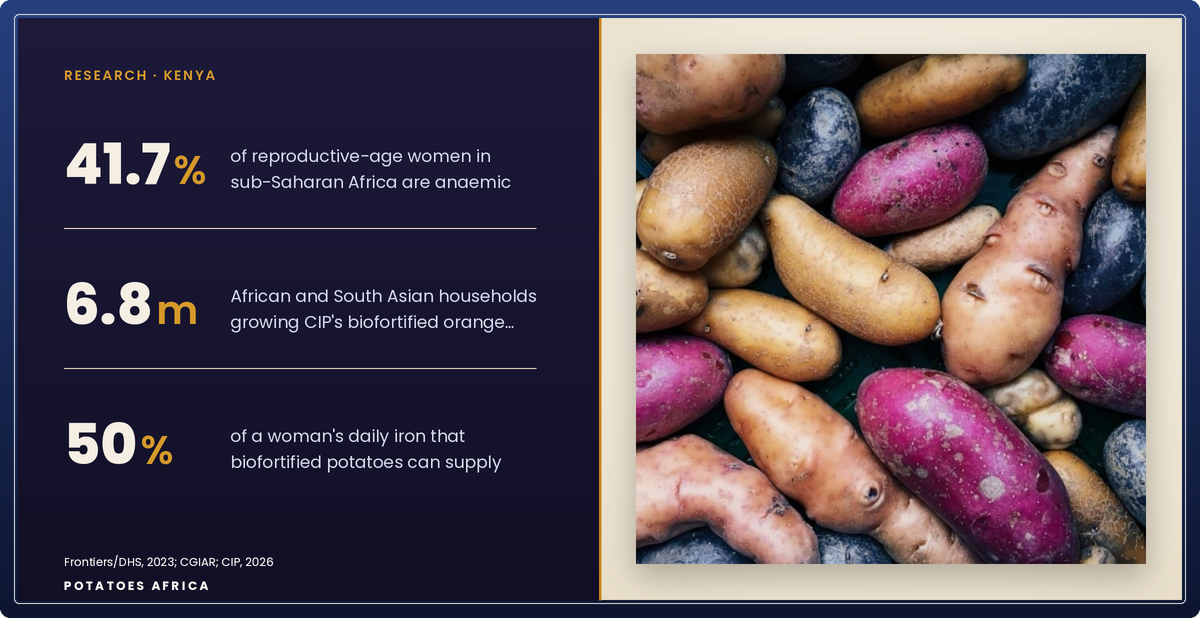
Her signature contribution is the iron-biofortified potato. Burgos led the first human studies showing that iron from potatoes is highly bioavailable, and that biofortified varieties deliver substantially more absorbable iron than conventional ones — enough, CIP reports, to meet up to half of a woman's daily iron needs in places where potatoes are a dietary staple. The method asks nothing of consumers: no new crop, no change in habit, simply a more nutritious version of a potato already on the plate. The varieties are now being disseminated across the central Peruvian highlands, where anaemia remains entrenched.
The logic travels well. Anaemia is severe and stubborn across Africa's potato belt: analyses of Demographic and Health Survey data put pooled prevalence among reproductive-age women in sub-Saharan Africa near 42%, against a global average of about 30%, and in East African children under five it exceeds 50% in several countries. Iron deficiency is the single largest driver, behind roughly half of all cases.
Those same highlands are where potato has become a pillar crop. A study in the journal Potato Research ranks it among East Africa's top ten strategic crops for food and income security — grown mainly by smallholders across Kenya, Ethiopia, Rwanda, Tanzania and Uganda, with consumption rising as incomes grow and cities expand. In Kenya it now trails only maize.
Africa has run this playbook before, with a CIP crop. The institute's orange-fleshed sweetpotato, bred on the continent to carry provitamin A, won the 2016 World Food Prize as the "single most successful example of biofortification," and has since reached more than 6.8 million households across Africa and South Asia.
The iron potato is not yet in African fields, and breeding varieties suited to local conditions and tastes takes years. But the elements align: a heavy anaemia burden, a staple eaten in quantity, and a proven route for moving biofortified tubers from a research station to the family table.
Frequently asked
What is a biofortified potato?
A potato bred to carry higher levels of an essential micronutrient — here, iron — so that eating the ordinary crop delivers more nutrition without supplements, fortified products or any change in diet.
How can an iron-biofortified potato help with anaemia?
Iron deficiency is the leading cause of anaemia. CIP's human studies found the iron in these potatoes is highly absorbable, supplying up to half of a woman's daily iron need in places where potatoes are eaten in volume — letting a staple crop double as a nutrition intervention.
Why does this matter for Africa?
Anaemia affects roughly four in ten reproductive-age women in sub-Saharan Africa, and potato is a fast-growing highland staple across East Africa. The continent has already scaled CIP's biofortified orange-fleshed sweetpotato to millions of households, suggesting a workable path for iron-rich potatoes too.
The week in African potato, in your inbox
Production, trade, policy and prices across the continent — one email, no noise.