Egypt's potato corridor to Rotterdam runs on Dutch seed and a narrow calendar
Egypt's potato trade with the Netherlands runs in both directions at once, and that reciprocity — more than price — is what sustains it. Certified Dutch seed moves south to Egyptian growers; months later, the table crop raised from it sails north into Rotterdam. According to a trade guide published by peitrade.com and summarised by the industry site potatoes.me, the loop gives the Netherlands a two-sided commercial relationship with Egypt rather than a one-way sourcing line, while handing Egyptian growers a quality floor tied to the genetics they buy in.
The northbound leg turns on timing. Egypt's winter and spring harvests deliver firm table stock from roughly February to May, ahead of northern Europe's own new-season crop. Dutch importers absorb that volume for domestic packing and for onward re-export across the bloc, and the guide places Egypt among the largest non-EU suppliers of fresh potatoes into the union. The trade is structured as a handoff rather than a contest for permanent share: Egyptian volume fills a seasonal absence, then withdraws.
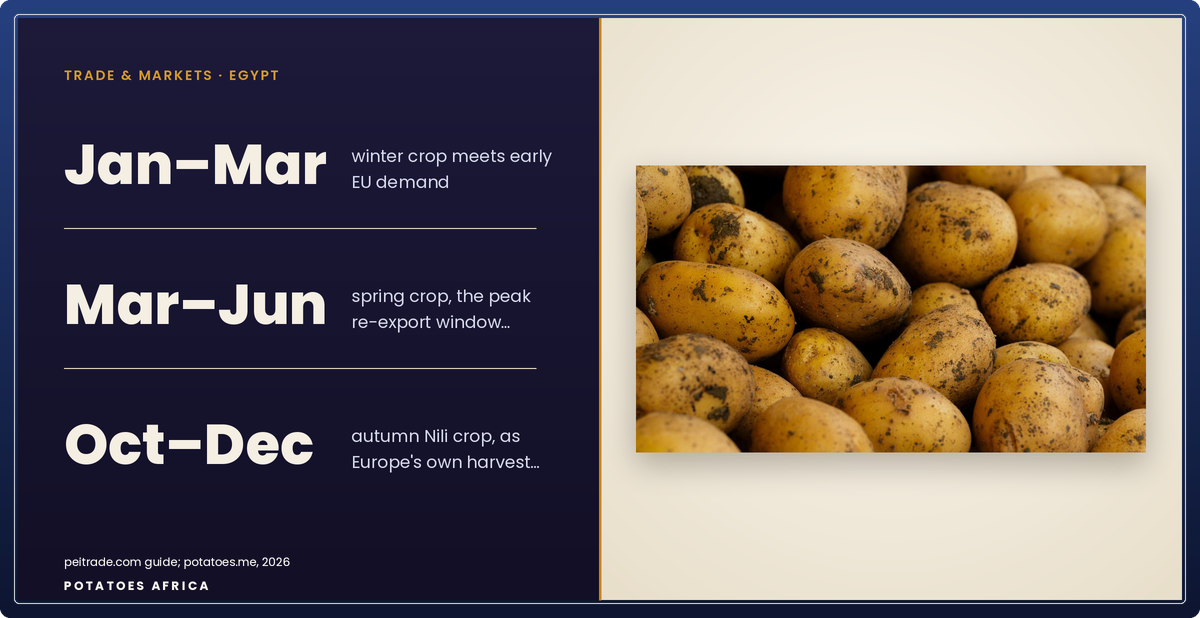
That absence has a shape. Three harvest windows map onto the corridor — a January-to-March winter crop meeting early demand, a March-to-June spring crop that is the peak re-export period through Rotterdam, and an October-to-December autumn, or Nili, crop that gives way as Europe's own harvest arrives. Variety follows function: Spunta, Diamant and Cara carry the table trade, while Lady Rosetta and Hermes serve a smaller chipping segment.
The stiffer constraint is regulatory. Clearing the EU requires a phytosanitary certificate satisfying the bloc's brown rot, or Ralstonia, and ring rot protocol; residue-limit compliance with full traceability; and grading to EU marketing standards that tolerate little greening or damage. Farm and packhouse certification — GLOBALG.A.P, HACCP or BRCGS, with GRASP often added — is treated as a baseline rather than an advantage. Consignments travel by reefer or ventilated sea freight from Alexandria or Damietta, held near 4–8°C to head off condensation and premature greening.
Individually, none of that is exotic for EU-bound produce. Stacked, it changes the character of the trade. A designated pest-free growing zone, a named pathogen protocol and a narrow temperature band make market access a standing operational cost rather than a border formality cleared once.
The implication for Egyptian exporters is that the corridor rewards continuity over opportunism. Europe's planting calendar fixes the window; the seed relationship and the paperwork decide who is still shipping into it next season.
Frequently asked
When do Egyptian table potatoes reach the EU?
Mainly February to May, from Egypt's winter and spring harvests, arriving ahead of northern Europe's own new-season crop.
Does Egypt buy potatoes from the Netherlands as well as sell to it?
Yes. Egypt is a significant buyer of certified Dutch seed potatoes, which underpin the quality of the table crop it later exports back into the EU.
What does an Egyptian shipment need to clear EU import rules?
A phytosanitary certificate meeting the EU's brown rot and ring rot protocol, residue-limit compliance with full traceability, grading to EU marketing standards, and farm and packhouse certification such as GLOBALG.A.P and HACCP or BRCGS.
In Egypt, the test for Western potato varieties isn't genetics — it's local proof
How Egypt turned the desert into Africa's potato export engine
The missing middle: why aggregation decides who profits from potatoes
The week in African potato, in your inbox
Production, trade, policy and prices across the continent — one email, no noise.