Kenya bets on soilless seed to break its certified-seed bottleneck
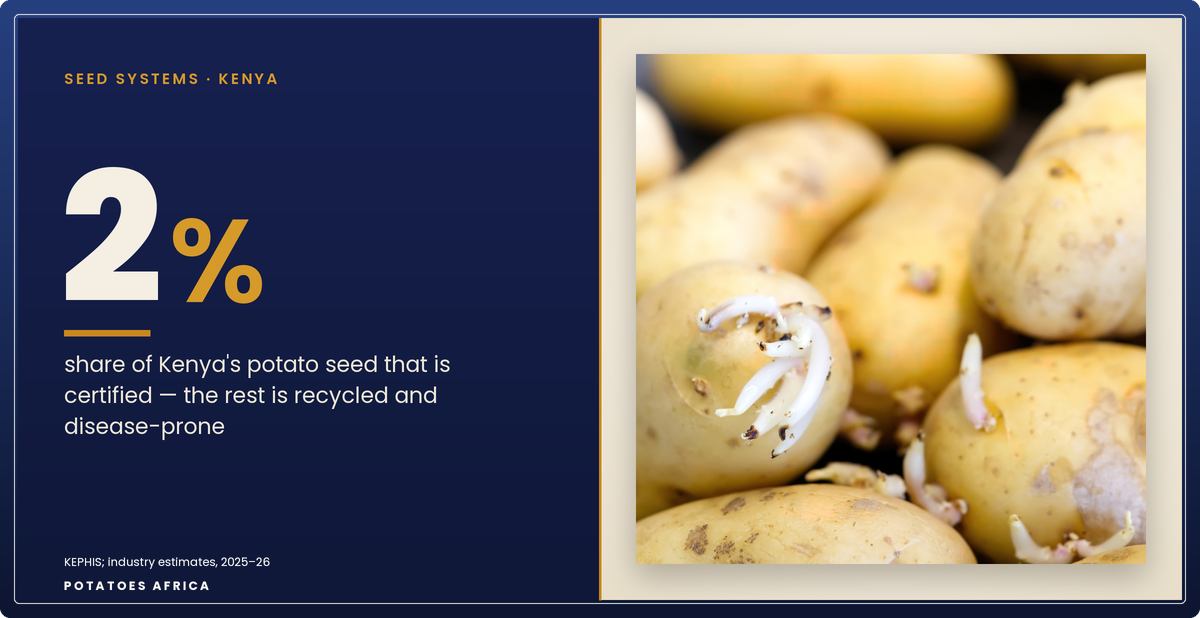
Kenya's potato sector runs on the wrong seed. The crop is the country's second most important food staple after maize, grown by an estimated 600,000 to 800,000 farmers, producing well over a million tonnes a year and valued by the National Potato Council of Kenya at tens of billions of shillings. Yet national certified-seed production meets only about 2% of demand. The rest is farm-saved or market-bought material that degenerates over successive plantings and carries soil-borne diseases such as bacterial wilt and late blight.
Demand for clean seed is climbing as the market shifts from table potatoes toward processing. When KFC ran short of imported fries in 2022 and briefly swapped them for ugali, the backlash pushed quick-service chains toward locally grown processing varieties such as Markies, raising the quality bar for growers, as documented in recent sector research published by Springer. By 2024 Kenya had registered 77 varieties and seen more than 30 private seed companies enter multiplication — but foundation-seed supply and the perishability of seed tubers still throttle the formal system.
The emerging fix is to take seed production out of the soil entirely. Hydroponic and aeroponic systems raise clean, disease-free mini-tubers in tightly controlled environments, sidestepping the soil-borne disease and land-shortage problems that have constrained conventional multiplication at KALRO's Tigoni centre and the older state seed farms. Industry observers increasingly frame these controlled-environment methods as the long-term answer to the certified-seed shortage, feeding cleaner foundation stock into the multiplication chain.
The catch is what happens after the lab. Seed potatoes are bulky and quick to sprout, and without cold storage and reliable distribution even clean seed struggles to reach smallholders — the same logistics gap that has kept certified-seed uptake low for decades. Building that cold chain is the unglamorous half of the problem.
The stakes are unusually visible this year: Kenya hosts the World Potato Congress in 2026, putting both its seed problem and its experiments to solve it on a global stage.
The week in African potato, in your inbox
Production, trade, policy and prices across the continent — one email, no noise.