The Seed Reckoning: Africa's potato seed gap, by the numbers
One number explains more about African potato yields than any other: the share of farmers planting clean seed. By the International Potato Center's reckoning, most of Africa's roughly six million potato farmers grow far below the global average, and the single biggest reason is seed.
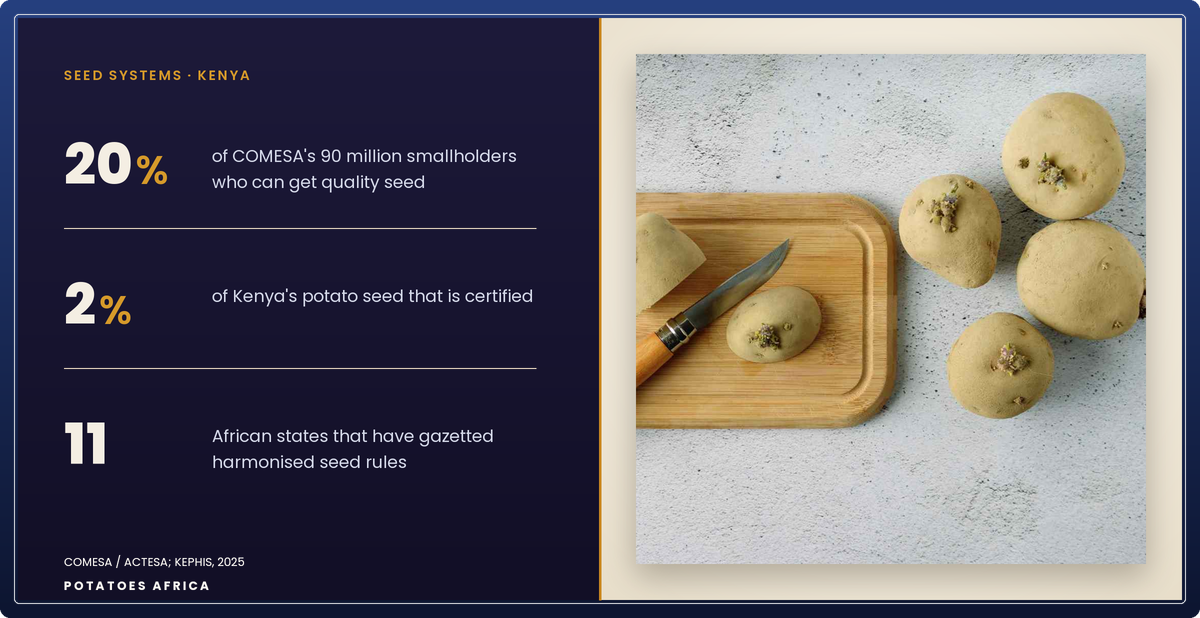
The continental picture is one of scarcity. The Alliance for Commodity Trade in Eastern and Southern Africa estimates that only about 20% of the COMESA region's 90 million smallholders can access quality seed of any crop; for potato the figures are starker still. In Kenya, certified seed meets just 2% of national demand. In Ethiopia, decades of breeding have produced 29 improved varieties, yet yields sit near 12 tonnes a hectare because clean seed of them rarely reaches farmers. In Nigeria, average yields languish at 3.8 tonnes against an achievable 20. Across all of them, farmers replant degenerating tubers that accumulate bacterial wilt, viruses and late blight.
The consequences compound. Poor seed caps yields, which caps incomes, which limits what farmers can invest in better seed — a trap that has held the continent's potato productivity below its potential for decades, even as demand from cities and processors climbs.
But the response is, for the first time, systemic. Three things are converging. Decentralised multiplication is putting seed production in farmers' hands — Malawi's roughly 107 community multipliers, Rwanda's seed cooperatives, Tanzania's minituber farms. Controlled-environment technology — aeroponics and hydroponics in Kenya, climate-resilient greenhouses in Rwanda — is producing clean foundation stock faster than soil ever could. And regional rule harmonisation is beginning to let clean seed cross borders to where it is short. New genetics are arriving too: Rwanda's 11 newly approved varieties, its first refresh in three decades, and the 3R-gene potatoes engineered for complete late-blight resistance now nearing approval in Kenya and Uganda.
None of this is finished. The plumbing — cold stores, inspectors, distribution, finance — lags the ambition, and seed remains the bottleneck it has long been. But for the first time the pieces of a working African potato seed system exist in the same decade. The reckoning is whether they can be connected before another harvest slips by on recycled seed.
The week in African potato, in your inbox
Production, trade, policy and prices across the continent — one email, no noise.