The 30-year hunt for a blight-proof potato reaches Africa's fields
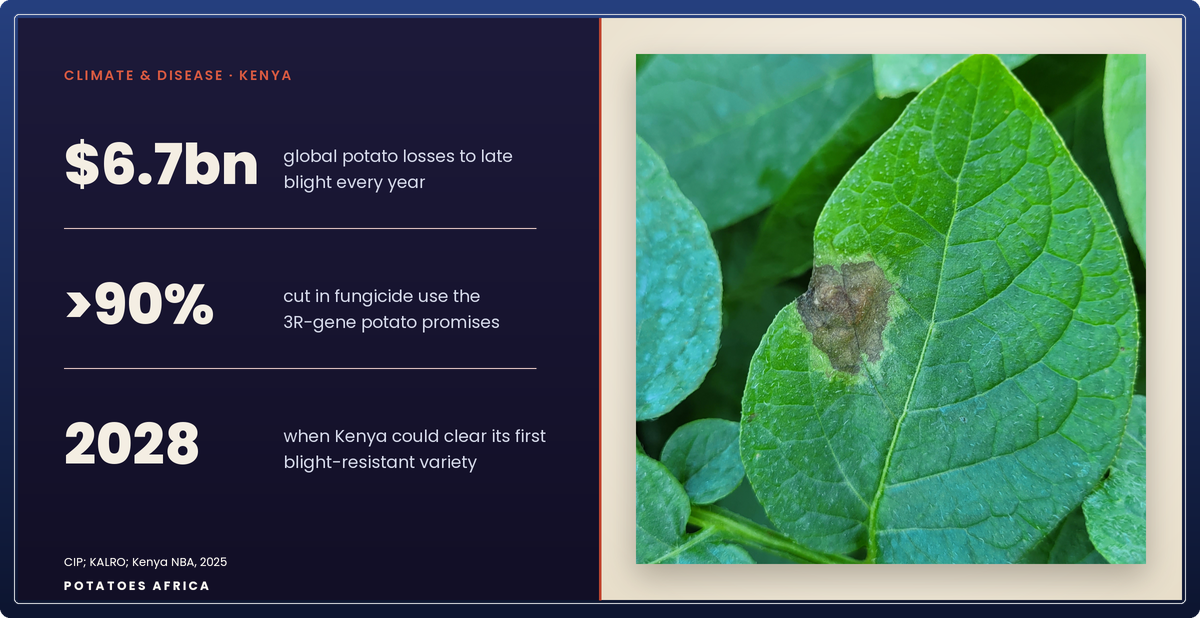
Late blight is the potato's oldest enemy — the Phytophthora infestans water mould behind the Irish famine — and it remains the most destructive disease in African potato fields, causing losses that run from a tenth of a crop to total failure. Worldwide it destroys an estimated 15 to 30% of output each year, worth around $6.7 billion.
For decades the only defence has been fungicide, sprayed repeatedly and often too late, eating into smallholder earnings and exposing farmers to chemicals. Conventional breeding offered little help: moving a single resistance gene from a wild potato relative into a farmer-preferred variety can take up to 46 years.
Biotechnology has now done in a few years what breeding could not. Scientists at the International Potato Center, working with Michigan State University and Kenya's KALRO, have stacked three resistance genes from wild Mexican and Argentinean potato species into varieties farmers already grow — Shangi, Asante and Tigoni in Kenya, and Victoria in Uganda. Because the pathogen must defeat all three genes at once, the resulting "3R-gene" potato has shown complete field resistance — not mere tolerance — in confined trials across Kenya, Uganda and Nigeria.
The promised payoff is large. Research suggests the 3R potato could cut fungicide use by at least 90% while sharply reducing the losses blight inflicts. In Uganda, the bioengineered Victoria known as Vic.172 survived blight that killed unprotected plants through multiple seasons of trials at the Kachwekano research institute.
The remaining hurdle is regulatory, not scientific. In Kenya, the National Biosafety Authority is finishing its assessment of the 3R Shangi, with public consultation due and farmers potentially planting by 2028; Uganda's blight-resistant Victoria likewise awaits biosafety clearance. As a safeguard against the pathogen eventually adapting, developers plan to deploy successor varieties carrying different resistance genes. The science of a blight-proof African potato is largely settled. Whether and when farmers get it now rests with regulators.
The week in African potato, in your inbox
Production, trade, policy and prices across the continent — one email, no noise.