South African growers are wiring their fields with weather stations to fight frost, blight and waste
South African potato growers are squeezed from several directions at once — unpredictable weather, rising input costs, persistent disease pressure — and the industry's response, according to an analysis published by Potatoes South Africa, has been a shift toward data-driven farm management, where real-time weather readings and localised forecasts replace guesswork on irrigation, spraying and frost protection.
The mechanism is a network of solar-powered weather stations, installed by Metos SA across the country, measuring temperature, rainfall, humidity, wind speed, solar radiation and leaf wetness at the farm level. That data feeds FieldClimate, a visualisation platform layering in a local forecast tied to each farm's nearest station. The value isn't the sensors themselves so much as what growers do with the readings. Irrigation is the clearest case: real-time evapotranspiration data, soil moisture monitoring and short-term forecasts let producers water to what the crop actually needs rather than a fixed schedule — a distinction that matters agronomically, since both under- and over-watering damage yield and quality, and economically, since it aligns water use with actual demand instead of a calendar.
Disease management follows the same logic. Early and late blight spread more readily when leaves stay wet for extended periods at mild temperatures, so pairing real-time weather data with disease models lets growers time fungicide applications to conditions rather than a routine schedule. Frost protection is the sharpest example of why hyper-local data beats a regional forecast: a regional outlook is of limited use to a grower whose field sits in a microclimate shaped by local topography, but a farm-specific station converts a broad climatic trend into a decision accurate enough to act on — flagging a sudden temperature drop with enough lead time to protect young, especially vulnerable plants before damage is done.
That network is now scaling up, with Potatoes SA adding 30 new Metos SA stations in key potato-growing areas of Limpopo, aimed at sharpening frost forecasts, generating early- and late-blight risk alerts, and producing seven-day evapotranspiration demand predictions. The expansion is industry-driven rather than a single vendor's rollout — partnerships already support 15 of the stations currently in operation, making this a co-funded piece of shared agricultural infrastructure. Metos SA's service centres keep the stations running, and FieldClimate combines that station data with satellite inputs and forecasts on one platform, so producers, consultants and advisors can pull mobile alerts, dashboards and custom reports from a single source.
The stated ambition extends past today's dashboards: as more stations come online and more seasons of data accumulate, Potatoes SA points to artificial intelligence and predictive modelling as the next layer that could make this climate intelligence easier to act on at field level. Whether that promise depends more on data volume, model development, or grower adoption isn't spelled out — but it's the open question that will decide how much of this stays a monitoring tool versus becomes a genuinely predictive one.

Soundararadjane S: India's potato-processing story and its lessons for Africa
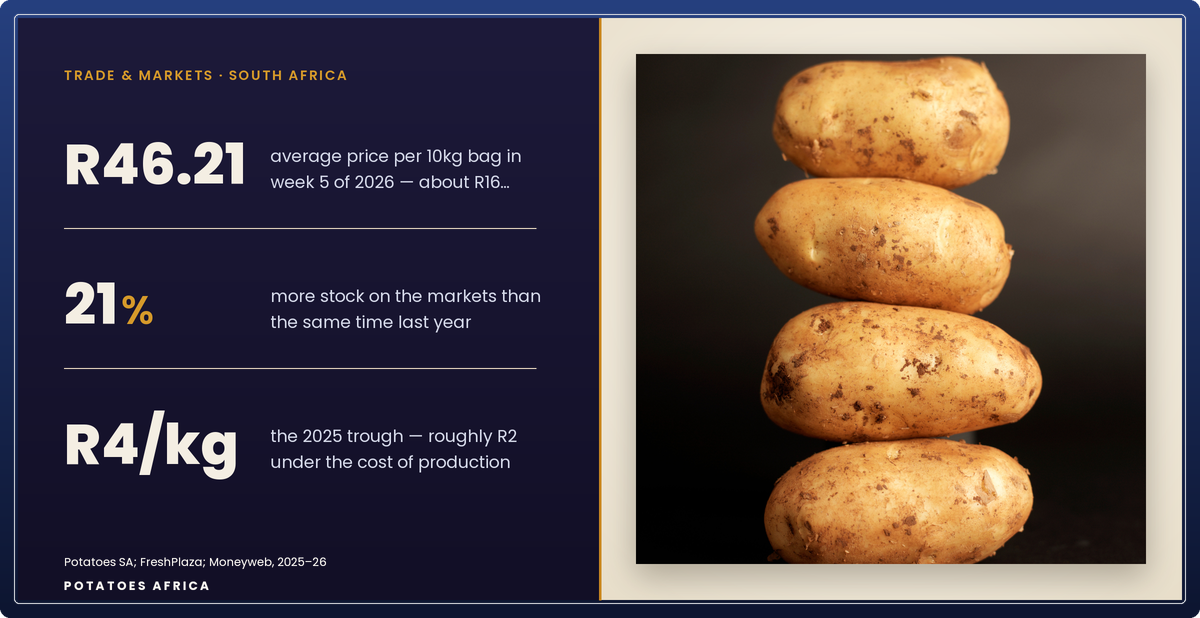
A bumper crop turns sour: South Africa's potato price slump runs into 2026
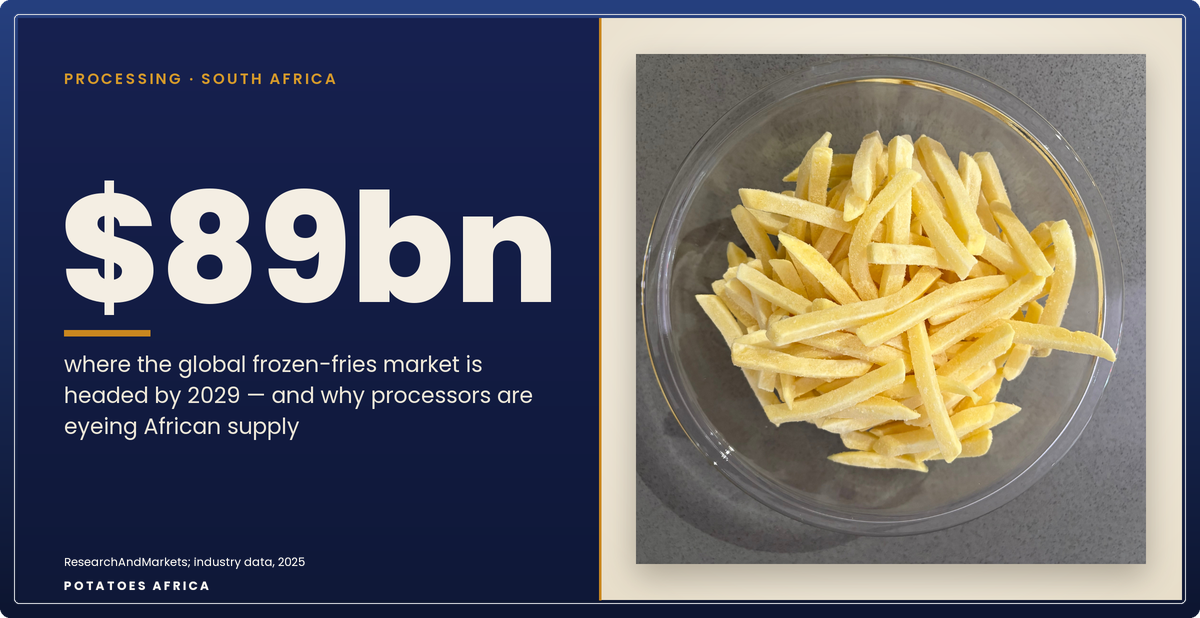
The fry frontier: why global processors are circling African potatoes
The week in African potato, in your inbox
Production, trade, policy and prices across the continent — one email, no noise.