Soundararadjane S: India's potato-processing story and its lessons for Africa
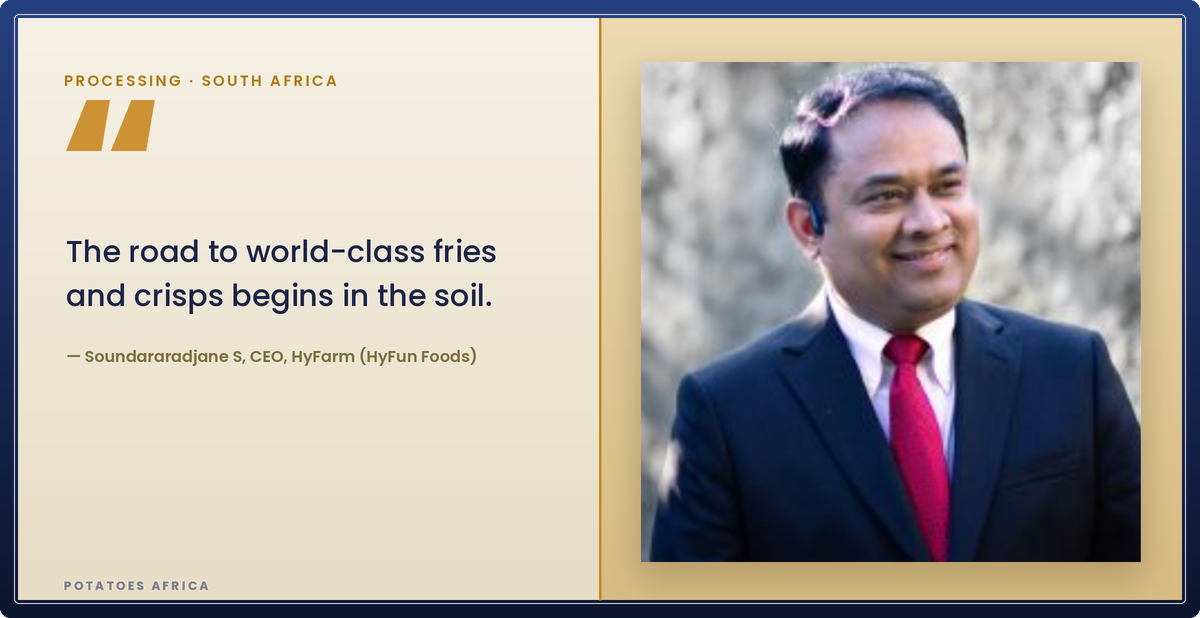
India grows more potatoes than almost anyone on earth, yet walk through the frozen aisle and the imbalance is obvious: only a fraction of that mountain of tubers ever becomes a fry or a crisp. Closing that gap is the work of Soundararadjane S, chief executive of HyFarm — the agribusiness arm of HyFun Foods, one of India's largest potato processors — who will bring "The India Potato Story" to the World Potato Congress in Kenya this October.
Soundararadjane is an industry veteran, with more than three decades in agriculture and earlier roles at Monsanto and ITC's Technico potato business before taking the HyFarm brief in 2024. HyFarm is HyFun's bet on backward integration: rather than buy potatoes on the open market, the company is building an integrated chain that runs from contract farming and seed development through processing to export, sourcing directly from growers to secure the specific varieties its factories need. The initiative has set itself the goal of bringing 30,000 farmers into that model by 2030.
His diagnosis of India's potato economy is blunt. The country produces more than 60 million tonnes a year — second only to China — but on the two products that define modern processing, crisps and frozen fries, it still punches below its weight. Part of the problem is varietal: the table potatoes most Indian farmers grow are not the processing varieties that fryers and crispers demand, so processors must cultivate a different supply base. Soundararadjane has argued that fixing this requires more than agronomy; it needs policy scaffolding — stable buy-back contracts that protect both farmers and processors, incentives and cold storage aimed at processing, and treating potato processing as a strategic food sector rather than an afterthought.
That argument is what he is taking to Naivasha. Billed as "The India Potato Story," his Congress session is built around India's production strength and the supply-chain transformation now under way — contract farming, variety development and the scramble to convert raw tonnage into higher-value processed product. It is, in effect, a live case study in how a large but under-processed potato economy tries to industrialise its value chain.
For an African audience, the relevance is direct, because the continent is wrestling with the same equation from the other side. Take South Africa, its most developed processing market. The country grows ample table potatoes, but — as importers and the industry body Potatoes SA both acknowledge — it lacks the processing-variety supply and the factory capacity to meet demand for frozen fries on its own, and so it imports to fill the gap. That reliance turned contentious: after an investigation found frozen chips from Belgium, the Netherlands and Germany were being dumped into the market, South Africa imposed steep anti-dumping duties, and fry imports duly fell — to roughly 10,000 tonnes in 2024, a 76% drop on the year before. Processing now accounts for about 15% of the country's planted potato area, and Potatoes SA says the local industry is growing behind that protection.
The same import dependence runs across much of Sub-Saharan Africa, where fast-growing demand from quick-service restaurants in markets such as Kenya and Nigeria is met largely by shipped-in fries. That is precisely where India's story cuts two ways. On one hand it is a template: HyFun's backward-integration model — secure the processing varieties, lock in farmer supply, then build capacity — is close to the playbook African processors say they need to escape the import trap. On the other it is a competitive signal: India is positioning itself as a low-cost exporter of processed potato products, eyeing the same global markets that African producers hope one day to supply rather than serve.
That tension is why Soundararadjane is worth hearing at a Congress staged, for the first time, in Sub-Saharan Africa. His session offers African processors and policymakers a real-time look at how a comparable producer is trying to climb the value chain — the varieties, the contracts, the cold storage, the policy asks. The harder question it poses is strategic: whether Africa builds its own processing varieties and capacity, or settles into being an import market that exporters, now including India, line up to supply. For a continent with the raw tonnage and the appetite, the difference is measured in jobs and value retained at home.
Frequently asked
Who is Soundararadjane S?
He is the CEO of HyFarm, the agribusiness arm of India's HyFun Foods, one of the country's largest potato processors. He has more than 30 years in agriculture, including roles at Monsanto and ITC's Technico, and leads HyFun's contract-farming and fresh-produce sourcing.
What will Soundararadjane S speak about at the World Potato Congress 2026?
He will present 'The India Potato Story,' on India's potato production strength and the supply-chain transformation behind its processing push — contract farming, variety development, and scaling crisps and frozen fries.
Why does India's potato processing matter to Africa?
Africa's frozen-fries demand is rising and largely met by imports. India shows how a big producer can build processing-variety supply and capacity through backward integration — a template for African processors — while also emerging as a low-cost exporter competing for the same markets.
How big is India's potato sector?
India produces more than 60 million tonnes of potatoes a year, second only to China, but processes a relatively small share into products like crisps and fries — the gap firms such as HyFun are working to close.
The week in African potato, in your inbox
Production, trade, policy and prices across the continent — one email, no noise.