Pooja Pandey: India's apical-cutting playbook, and its lessons for African seed systems
The obstacle standing between a smallholder and a good potato harvest is rarely effort — it is clean seed. That is as true in the fields of northern India as it is in the highlands of East Africa, and closing the gap is the work Pooja Pandey has spent years on. A potato scientist with the International Potato Center (CIP), Pandey has taken a laboratory technique and turned it into farmer-run businesses across the Indian state of Haryana — and at the World Potato Congress in Kenya this October, that Indian story converges with Africa's.
Based in Haryana as a senior research associate with CIP, Pandey came to the centre in 2019 after completing a doctorate in horticulture and a spell as a university assistant professor. Her brief has centred on quality seed: evaluating germplasm to identify the varieties farmers actually want, promoting early-maturing types suited to India's cereal-based cropping systems, and, above all, widening farmers' access to clean planting material in a region long dependent on seed trucked in from far away.
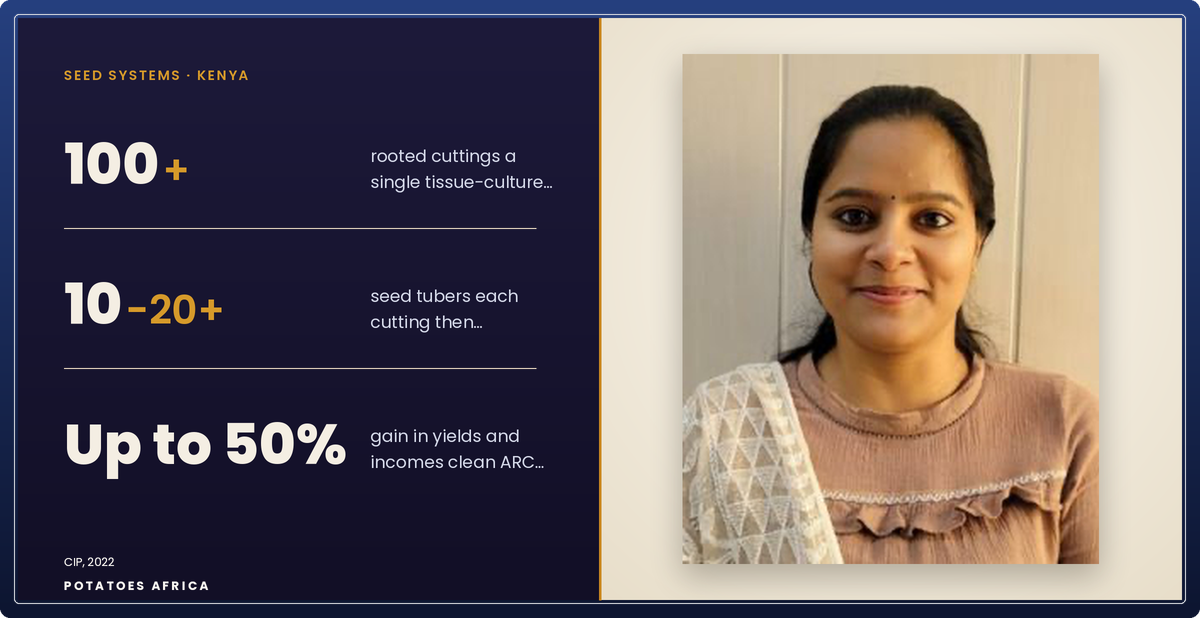
That dependence is the crux. According to CIP, much of India's formal seed system sits roughly 2,000 kilometres from potato belts like Haryana, and hauling seed that distance can add around 30% to its price. With seed already accounting for about half of a farmer's production costs, many simply replant tubers saved from the last crop — cheaper, but a fast route to disease build-up and falling yields. Pandey's response has been to bring early-generation seed production close to the farm through apical rooted cuttings (ARC), a low-cost alternative to capital-hungry systems such as aeroponics. The method is strikingly productive: CIP reports that a single tissue-culture plantlet raised in a screenhouse yields more than 100 rooted cuttings, and each cutting, once planted, produces ten to twenty tubers or more that feed into the certified-seed chain.
Pandey's distinctive contribution has been less the biology than the business model around it. In Haryana she built an ARC system that links marginal farmers in the hills, who raise the cuttings, with large seed growers on the plains who multiply them — creating what she has called "ARC villages" and, alongside them, a farmers' production association to keep the supply chain running. It is a template for turning a clean-seed technology into rural income, and CIP's wider ARC programme has shown how far that can reach: clean, affordable seed can lift yields and incomes by as much as 50%, and in states such as Meghalaya the technology has proved especially suited to women, who have taken it up as seed entrepreneurs.
It is that combination of science and enterprise that earns Pandey a place at the Congress. While the programme lists her among its speakers without publishing an individual session title, her expertise sits squarely within one of the event's headline threads: the Apical Rooted Cuttings Network, a global working group being formalised in Kenya under CIP's Monica Parker and the Nairobi-based scientist Dinah Borus. The network exists precisely because ARC has become an efficient way to produce early-generation seed in many countries across Africa and Asia — and Pandey's Haryana rollout is one of the most developed Asian use cases to set beside the African experience.
For African seed systems, that exchange is more than academic. Kenya, the Congress host, has taken ARC furthest on the continent: CIP's programme there has put clean seed within reach of tens of thousands of farmers, and the national regulator KEPHIS has folded apical cuttings into the formal seed system as certified starter material. Rwanda is pushing in the same direction to close a stark gap, where certified seed meets only around 5% of national demand. In both, the technical case for ARC is settled; the harder question is the one Pandey has spent years answering — how to make clean-seed production a business that marginal farmers can run and profit from. Her model of linking smallholders to commercial multipliers, formalising farmer associations and deliberately opening the technology to women speaks directly to what Kenyan and Rwandan seed systems are trying to build.
That is the value of putting an Indian ARC practitioner on an African stage. The 13th World Potato Congress, from 26 to 30 October at Naivasha, is the first held in Sub-Saharan Africa, and its whole premise is partnership across borders. Pandey embodies the version that matters most to smallholders: not a headline pledge, but the practical knowledge of how a lab-born technique becomes clean seed in a farmer's field and money in their pocket. If the ARC Network does its job, the lessons she carries from Haryana will not stay in India — they will travel to the highlands of Kenya, Rwanda and beyond.
Frequently asked
Who is Pooja Pandey?
She is a potato scientist and senior research associate with the International Potato Center (CIP), based in Haryana, India. She is known for introducing apical rooted cuttings in Haryana and building farmer-run businesses around clean seed production.
What will Pooja Pandey speak about at the World Potato Congress 2026?
The Congress lists her among its speakers without publishing an individual session title, but her expertise lies in apical rooted cuttings and quality seed — central to the event's Apical Rooted Cuttings Network, being formalised in Kenya.
What are apical rooted cuttings?
They are potato planting materials grown from tissue-culture plantlets in a screenhouse. CIP reports one plantlet yields more than 100 cuttings, and each cutting produces 10 to 20 or more tubers, making it a low-cost way to multiply clean, disease-free seed close to farms.
Why does Pooja Pandey's India work matter for Africa?
Apical rooted cuttings are increasingly used across African seed systems, notably in Kenya and Rwanda. Pandey's Haryana model — linking marginal farmers to commercial multipliers and opening the technology to women — offers transferable lessons for making clean-seed production a viable business.
The week in African potato, in your inbox
Production, trade, policy and prices across the continent — one email, no noise.